
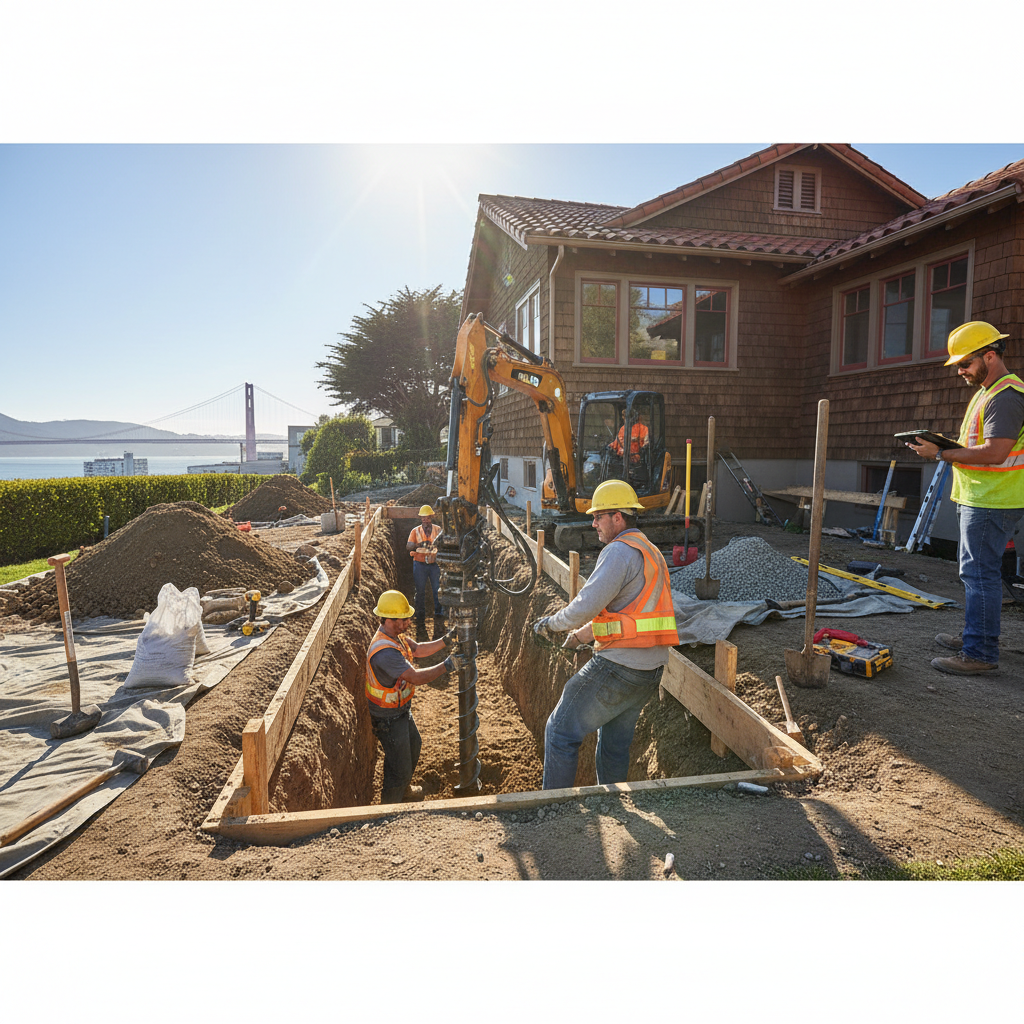
Building on Solid Ground: Exploring Essential Foundation Repair Options for Bay Area Homes
The San Francisco Bay Area is renowned for its vibrant culture, stunning landscapes, and innovative spirit. Yet, beneath the picturesque surface of Marin County hillsides, the bustling urban sprawl of San Francisco, the Silicon Valley expanse of San Jose, or the serene vineyards of Napa and Sonoma, lies a complex geological reality. Homes across this diverse region—from Monterey's coastal communities to Oakland's established neighborhoods—are built upon an intricate tapestry of soil types, seismic fault lines, and varying hydrological conditions. These unique environmental factors mean that Bay Area homeowners are particularly susceptible to foundation issues, making robust and informed foundation repair a critical concern.
At LVI Engineering, we understand the specific challenges faced by properties in Northern California. With decades of experience as a heavy civil engineering and construction firm, we approach every project with an unrivaled work ethic and precision, extending the legacy of quality established by our founder, Thomas H. Lavey. When your home’s structural integrity is compromised, identifying the correct repair strategy is paramount. This article will explore the primary foundation repair options available, offering insights into how these solutions address the distinct geotechnical characteristics of the Bay Area.
Understanding the Bay Area’s Foundation Challenges
Before delving into solutions, it’s crucial to grasp why foundation problems are so prevalent here.
- Seismic Activity: The region is crisscrossed by major fault lines, most notably the San Andreas and Hayward faults. Earthquakes, even minor tremors, can induce stress and movement in foundations, leading to cracks, settlement, and structural shifts.
- Diverse Soil Conditions: The Bay Area boasts an incredibly varied geology. From expansive clay soils that swell and shrink with moisture changes (common in areas like the East Bay and parts of San Jose) to loose, sandy soils susceptible to liquefaction (especially near the Bay shoreline in San Francisco and Oakland), and bedrock formations, each presents unique challenges.
- Hilly Topography: Many desirable neighborhoods, particularly in Marin County, San Francisco, and the Berkeley-Oakland hills, are built on slopes. This necessitates careful consideration of retaining walls, erosion control, and lateral stability to prevent foundation movement caused by soil creep or landslides.
- Water Management: Heavy winter rains, especially after prolonged dry spells, can saturate soils unevenly, leading to differential settlement or hydrostatic pressure against basement walls.
Recognizing these underlying causes is the first step toward selecting an effective and lasting foundation repair. A thorough geotechnical investigation by experienced engineers is always essential to accurately diagnose the problem.
Common Foundation Repair Options for Bay Area Homes
When foundation issues arise, a range of specialized techniques can be employed to restore stability and integrity. The choice depends heavily on the specific cause and extent of the damage.
1. Helical Piles and Push Piers: Deep Foundation Solutions
For significant settlement or unstable soil conditions, deep foundation solutions like helical piles or push piers are often the most robust and reliable option. This is particularly true in areas with problematic soils or where future seismic activity is a concern.
-
Helical Piles: These are steel shafts with helical plates (like a large screw) that are hydraulically twisted deep into the ground until they reach stable, load-bearing soil or bedrock. Once installed, they are typically connected to the existing foundation using a bracket system, effectively transferring the structural load from the unstable surface soil to the stronger deeper strata.
- When Used: Ideal for addressing significant settlement, lifting sunken foundations, supporting new construction on challenging sites, and providing seismic reinforcement. They are highly effective in areas with expansive clays or liquefaction-prone soils, common throughout the Bay Area. LVI Engineering frequently deploys helical piles for both residential and commercial projects, offering a minimally invasive installation process with immediate load-bearing capacity. For a deeper dive into their applications, explore our article on what are helical piles used for in modern engineering and construction.
- Benefits: Quick installation, immediate load-bearing capacity, minimal vibration, environmentally friendly, and highly adaptable to various soil types. They are particularly well-suited for tight access areas often found in dense urban environments like San Francisco.
-
Push Piers: Similar to helical piles in purpose, push piers consist of steel pipe sections driven hydraulically into the ground beneath the foundation until they meet resistance. They are then connected to the foundation with brackets, transferring the load to the stronger soil layer.
- When Used: Often preferred for homes with concrete slab foundations that have settled due to poor soil conditions.
- Benefits: Can stabilize heavily loaded structures and often provide a means to lift a settled foundation back to its original position.
2. Underpinning (Traditional Pier and Beam)
Underpinning refers to the process of strengthening or increasing the depth of an existing foundation. While helical piles are a modern form of underpinning, traditional methods involve extending the foundation deeper.
-
Concrete Piers/Footings: This method involves excavating sections beneath the existing foundation and pouring new concrete piers that extend to a more stable soil layer. The new piers are then connected to the existing foundation.
- When Used: Effective for localized settlement or increasing the load-bearing capacity of an older, shallow foundation. This is a common solution for many older homes in Oakland or Berkeley with original shallow foundations.
- Benefits: Provides a strong, permanent solution.
- Considerations: More invasive and time-consuming than helical piles, requiring significant excavation.
3. Slab Jacking / Polyurethane Foam Injection
For minor to moderate settlement of concrete slabs (such as driveways, patios, or even concrete slab-on-grade foundations), these techniques offer a less invasive repair.
-
Slab Jacking (Mudjacking): Involves drilling small holes through the settled concrete slab and pumping a mixture of cement, sand, and other additives (the "slurry") beneath it. The hydraulic pressure lifts the slab back to its desired elevation.
- When Used: Ideal for lifting concrete slabs that have settled evenly without significant cracking, or for filling voids beneath a slab.
- Benefits: Cost-effective for minor issues, relatively quick, and less disruptive than full slab replacement.
-
Polyurethane Foam Injection: Similar to mudjacking, but a high-density polyurethane foam is injected beneath the slab. The foam expands rapidly, filling voids and lifting the slab.
- When Used: Preferred for lighter lifting or filling voids, particularly useful where minimal weight is desired (e.g., specific commercial applications or residential garages). It's also effective in tight spaces.
- Benefits: Lighter weight than slurry, faster curing time, and water-resistant properties.
4. Shoring and Lateral Support Systems
In the Bay Area’s hilly terrain, or when excavation is required adjacent to an existing structure, maintaining lateral stability is paramount. Shoring refers to the process of temporarily or permanently supporting a structure to prevent collapse or movement during construction or repair activities.
- Temporary Shoring: Used to support adjacent structures or excavated areas while foundation work is underway. This could involve steel beams, hydraulic props, or timber systems.
- Permanent Shoring/Retention Systems: For homes on slopes or near retaining walls that show signs of failure, permanent shoring, often involving soil nails, tie-backs, or soldier pile walls, might be necessary to stabilize the hillside and protect the foundation from lateral movement or erosion. This is crucial for properties in areas like the Oakland hills or coastal sections of Marin and Monterey.
5. Concrete Repair and Crack Sealing
For foundations exhibiting cracks without significant settlement or structural displacement, targeted concrete repair can often suffice.
- Epoxy Injection: Fine cracks (hairline to ¼ inch) in concrete foundations can be repaired by injecting epoxy, which bonds the concrete back together, restoring strength and preventing water intrusion.
- Polyurethane Injection: For active, leaking cracks, polyurethane can be injected. It reacts with water to form a flexible seal, effectively stopping leaks and preventing further water damage.
- Patching and Resurfacing: For surface-level damage, spalling, or minor cosmetic issues, patching compounds or resurfacing materials can be applied. However, it's vital to ensure these are purely cosmetic if the underlying issue is structural.
At LVI Engineering, our skilled concrete workers possess expertise in formwork, reinforcement, pouring, and curing techniques, ensuring the highest quality standards for concrete structures, including repairs and new foundations.
6. Drainage and Moisture Management Solutions
Often, foundation problems stem from poor drainage around the home, especially with the Bay Area's rainy seasons. Addressing water intrusion is a critical preventative and sometimes curative measure.
- French Drains: Installing subsurface drains to divert water away from the foundation.
- Sump Pumps: For basements or crawl spaces prone to flooding.
- Grading: Reshaping the landscape around the home to ensure water flows away from the foundation. LVI Engineering's expertise in grading and excavation is invaluable for these types of solutions, creating a proactive defense against water-related foundation issues.
- Gutter and Downspout Systems: Ensuring they are properly installed and maintained to collect and discharge rainwater away from the foundation.
Choosing the Right Foundation Repair Partner
Given the complexity and critical nature of foundation repair, selecting an experienced and reputable heavy civil engineering and construction firm is paramount. In the Bay Area, where geological conditions can vary dramatically even within a few blocks, a localized understanding is indispensable.
Look for a company that offers:
- Comprehensive Assessment: A thorough evaluation by qualified structural and geotechnical engineers.
- Integrated Solutions: The ability to handle everything from initial excavation and shoring to the final installation of deep foundation systems and concrete work.
- Local Expertise: A deep understanding of Bay Area soil conditions, seismic requirements, and local building codes in areas like San Francisco, San Jose, and the North Bay.
- Safety Focus: A strong commitment to safety, ensuring the protection of your property and workers throughout the project.
At LVI Engineering, we pride ourselves on delivering solutions that are not only effective but also meticulously planned and executed. Our team carries forward the legacy of ambition, hard work, and a solid reputation, ensuring that your Bay Area home stands on truly solid ground.
If you suspect your home has foundation issues, do not delay seeking professional advice. Early intervention can prevent minor problems from escalating into costly structural failures. Contact LVI Engineering today for an expert assessment and a tailored solution designed for the unique demands of the Bay Area’s challenging environment.


